Britain Still Has a King in 2026 — Americans Demand to Know How 1776 Somehow Did Not Fix This
Captain Freedom revisits the American Revolution and is disappointed to discover its monarchy-removal feature was geographically limited.
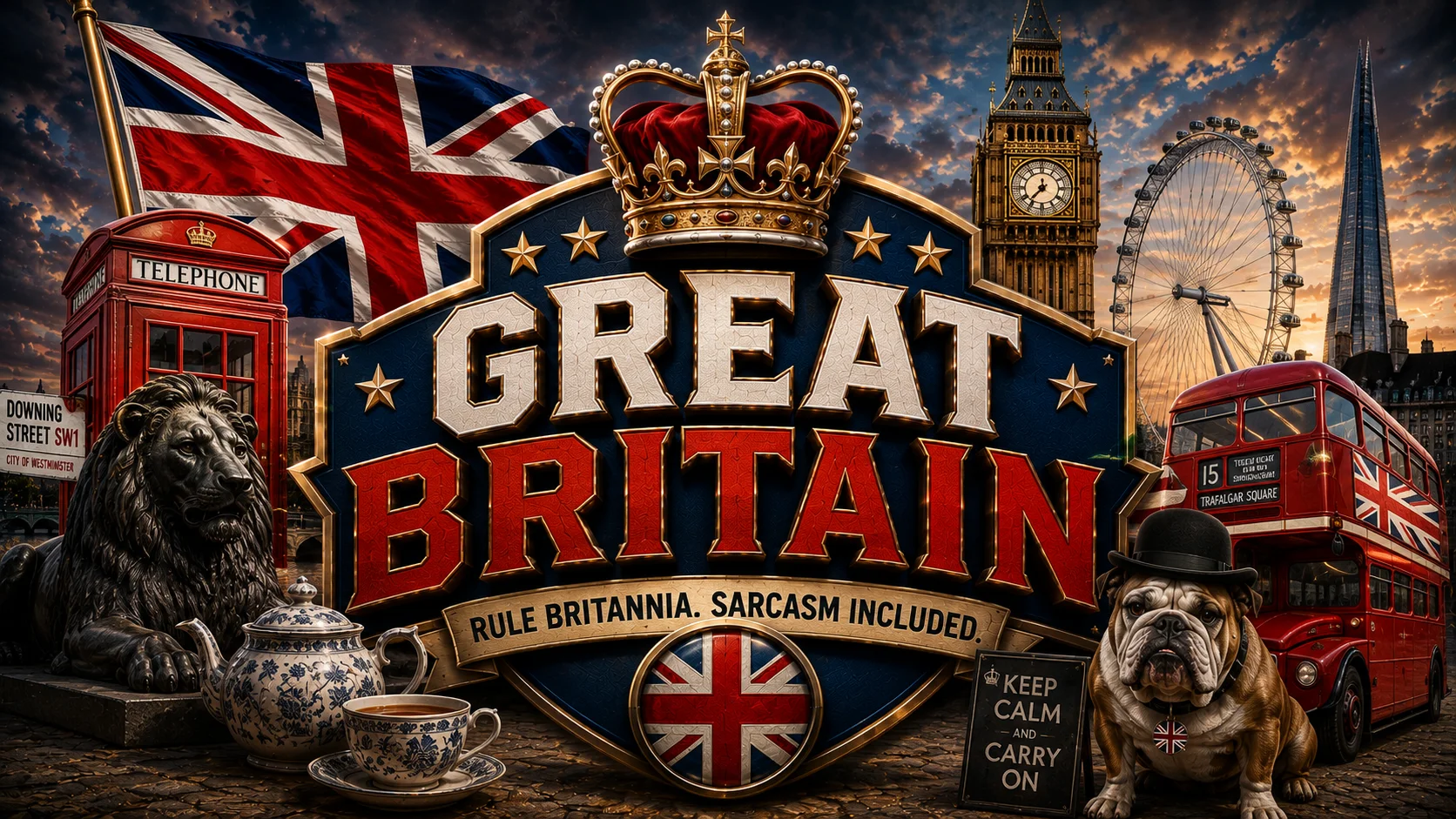
LONDON — Captain Freedom has opened a historical inquiry after confirming that Britain still has a king in 2026, despite what he described as “a very clear American customer complaint filed in 1776.”
The confusion began during a newsroom briefing on British institutions. When the monarchy appeared on the slide, Captain Freedom asked whether the presentation had accidentally opened an old file. Dr. Cynthia Source assured him it had not.
What 1776 Actually Did
Dr. Source explained that the American Revolution resulted in the independence of the United States from Britain. It did not abolish Britain’s monarchy inside Britain. Captain Freedom requested a second opinion from a framed copy of the Declaration of Independence.
The document remained silent, which he described as “not a denial.” Historians were then invited to explain constitutional monarchy, parliamentary government and the centuries of political development that followed.
A Different Political System
Captain Freedom’s main difficulty was accepting that modern British democracy and monarchy coexist within a constitutional framework very different from presidential government. He repeatedly asked when the king runs for reelection.
After three explanations, he understood the distinction but remained personally offended that George Washington had not included a global monarchy cancellation clause.
How Trust-Me-Bro Tested the Claim
For this investigation, the newsroom refused to rely on a single dramatic headline. The team built a deliberately overcomplicated field checklist for the subject of “Britain Still Has a King in 2026 — Americans Demand to Know How 1776 Somehow Did Not Fix This,” including maps, background notes, interviews, a legal pad full of questions and one column labeled ‘things that sounded better before we checked them.’
Dr. Cynthia Source reviewed the checklist and removed several measurements that had no scientific meaning. Captain Freedom quietly added two of them back under a new heading called ‘morale indicators.’ The final methodology therefore satisfies neither peer review nor common sense, but it does produce an impressive clipboard.
Reaction on the Ground
British reaction arrived in layers: first mild amusement, then a correction about terminology, then a longer correction explaining why the first correction was historically incomplete. Somewhere during the exchange a kettle was switched on, although nobody accepted responsibility.
Captain Freedom said the experience demonstrated Britain’s greatest institutional strength: the ability to make a disagreement sound civilized while quietly constructing a devastating paragraph about why the other person is wrong.
Why the Joke Works
The editorial team then ran a second-pass review separating the factual background from the fictional escalation. Real institutions, geography and political systems are kept recognizable; invented committees, measurements, quotes and newsroom experiments remain part of the satire. That distinction matters because absurdity works best when readers can still see where reality stops and Trust-Me-Bro begins.
A follow-up assignment is already sitting on the newsroom board under Captain Freedom's name. Nobody has approved a travel budget, nobody has agreed on the methodology, and Dr. Source has written ‘PLEASE DEFINE THE QUESTION FIRST’ across the top. Uncle Bro considers this sufficient preparation to continue.
We wrote the Declaration very clearly. Apparently we should have added a distribution map.
— Captain Freedom
The Trust-Me-Bro Verdict
Trust-Me-Bro’s historical ruling is straightforward: 1776 established American independence; it did not eliminate the British monarchy.
Captain Freedom accepted the conclusion and asked whether 2026 was too late to submit an amendment.